
 Hot Topics

gr8linux
@gr8linux_698854
3D Printing Fumes, Particles, and Food Safety: My Experience with PLA Pure
#My 3D Print Journey#
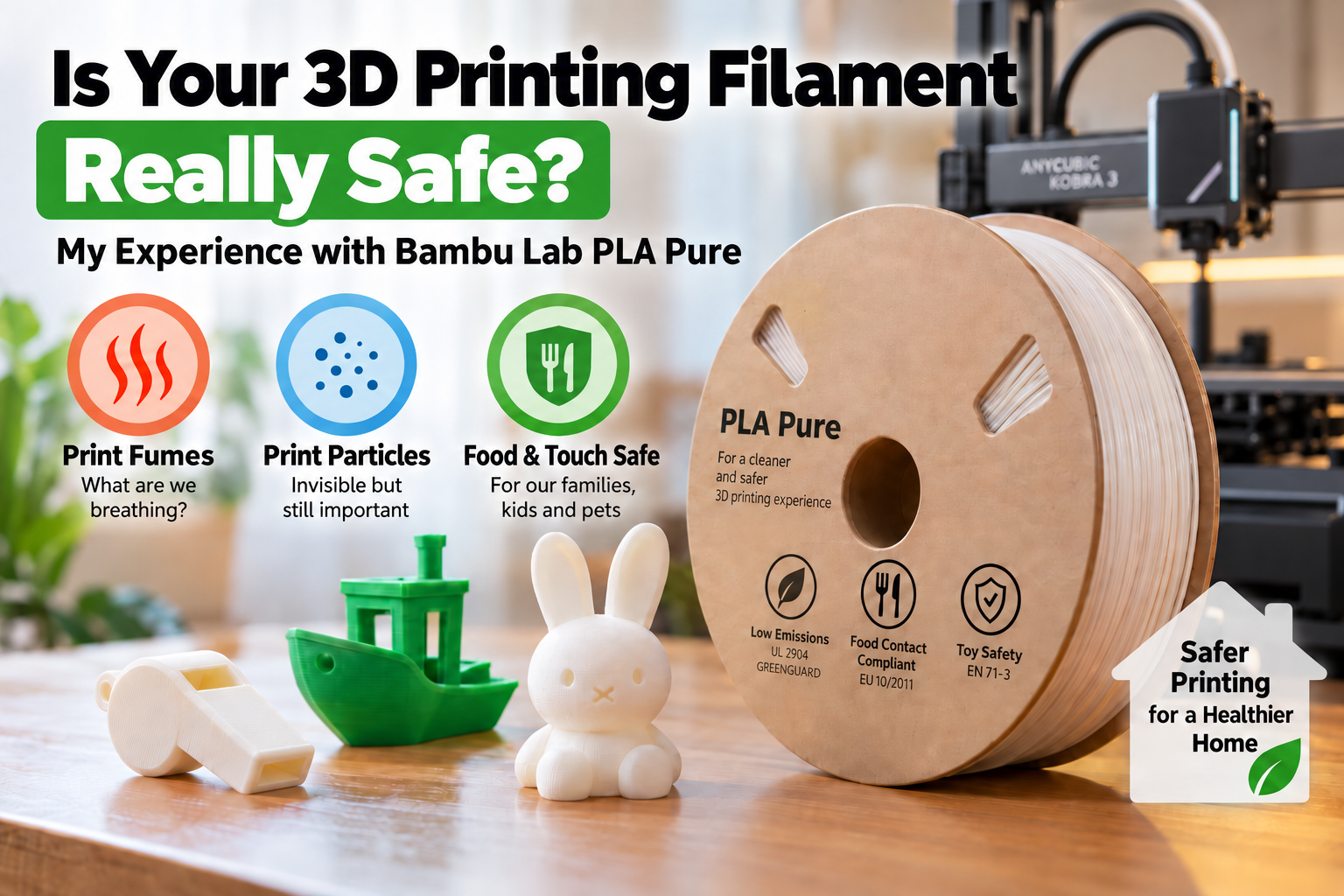
There are a few different areas of safety that I normally think about:
### 1. Print fumes
This is probably the most noticeable one.
Some materials can produce stronger fumes while printing. ABS, for example, is well known for producing more noticeable fumes and odor.
PLA is normally better in this area and is printed at a lower temperature, but this does not mean that it produces zero emissions. Ventilation is still recommended when printing indoors.
### 2. Particles from heated material
When plastic is heated and extruded, very small particles can also be released into the air.
You may not be able to see or smell these particles, but they are still something worth considering, especially when a printer is running for many hours inside a living space.
This is one reason why I became interested in **Bambu Lab PLA Pure**. According to Bambu Lab, PLA Pure has UL 2904 GREENGUARD certification for low particle and VOC emissions during printing.
### 3. Food contact and toys
Another question is what happens when our food, our children, or even our pets come into contact with a printed object.
This was important for me because I sometimes print toys and objects that children may touch or possibly put in their mouths.
Bambu Lab says that all ingredients used in PLA Pure comply with the EU 10/2011 requirements for materials intended for food contact. The material has also passed the EN 71-3 toy-safety standard.
For this reason, I prefer to use a material like PLA Pure for these kinds of prints rather than an unknown cheap PLA where I know very little about the additives or pigments used.
However, this does **not mean that every object printed with PLA Pure automatically becomes food-safe**.
The printer and nozzle must also be clean, and the layered structure of FDM/FFF printing creates small gaps where food and bacteria can remain. Bambu Lab also states that printed parts made with this material are not suitable for liquid foods, and PLA should not be exposed to temperatures above 60°C.
If you want to use a printed object for something like a spoon or another food-contact application, the design, printer cleanliness, surface finish, and possibly a suitable food-contact-safe coating also need to be considered.
### My experience with PLA Pure
I tried PLA Pure mainly for printing some toys, including a whistle for the kids, because these are the kinds of objects that might come into contact with their mouths.
The printing quality itself was good. I would describe it as behaving mostly like normal PLA.
The main issue I had was bed adhesion.
On my printer, PLA Pure did not stick very well to the heated bed with my original settings. I made a few small changes to the filament and print profile:
- Fan OFF for the first 3 layers
- Bed temperature increased to **65°C for the first layer**
After these changes, the bed adhesion improved quite a lot.
Overall, I like the idea behind PLA Pure. It is still a plastic material and should not be considered completely risk-free, but having documented ingredients, food-contact compliance, toy-safety certification, and independently tested low emissions gives me more confidence than using an unknown filament.
If you have experience with **Bambu Lab PLA Pure** or another low-emission or food-contact-safe filament, please share your thoughts.
Hopefully, over time we will have more materials that are safer to print at home and more environmentally friendly, while still allowing us to enjoy the fun side of 3D printing and making toys and useful objects.
### Reference
Please read the Bambu Lab PLA Pure user guide before printing. It contains important information about where and how this material should be used:
https://wiki.bambulab.com/en/filament/pla-pure
2026-10-04 17:55
15
0
0



 Hot Activities